Key Takeaways
- Drones are fast becoming a crucial component of contemporary business security, providing aerial surveillance, self-governing patrols, and AI-assisted threat detection that stationary cameras and human guards simply cannot compete with.
- Companies that employ drone security systems can monitor significantly more area with fewer resources, reducing both operational expenses and response times during security events.
- AI integration is propelling drone security to new heights — allowing for real-time pattern recognition, automated notifications, and predictive threat evaluation before incidents become severe.
- From warehouses and industrial locations to remote pipelines and expansive commercial campuses, drones are being utilized in virtually every business sector that manages high-value assets.
- Continue reading to learn how drones can be integrated with your existing CCTV and access control systems — and what the future of fully self-governing drone patrols might look like.
Drones are no longer solely military equipment or hobbyist gadgets — they’re actively revolutionizing the way businesses safeguard their people, property, and assets.
For years, the security industry has been grappling with various challenges. Increasing labor costs, expanding physical security gaps, and the growing sophistication of criminals are just a few of them. Traditional security tools were created for a different time. Stationary cameras can only monitor a fixed area. Human guards can only be at one location at any given time. By the time a threat is detected, it’s often too late to respond.
FlytBase, a platform that focuses on drone automation for security and surveillance operations, has been leading the charge in documenting how businesses across industries are using autonomous drone fleets to fill these critical gaps.
The Downfall of Conventional Security Techniques
Many businesses continue to use a mix of CCTV cameras, access control systems, and security staff. While this may seem like a comprehensive solution, it actually leaves significant gaps that malevolent individuals are increasingly taking advantage of.
Overcoming the Limitations of Fixed Cameras
Fixed surveillance cameras have a limited field of view. If you have a large facility — such as a warehouse, industrial yard, or commercial campus — you’ll have loading docks, rooftops, perimeter fencing, and outdoor spaces that just can’t be fully covered by stationary hardware. If you want to expand your camera coverage, you’ll need more equipment, more wiring, more maintenance, and more cost. Plus, a determined intruder who knows the layout of your cameras can move through the blind spots without being detected.
The Exorbitant Price of Depending Only on Human Security
Security personnel are costly. Taking into account salaries, benefits, training, turnover, and the natural constraints of human attention spans during lengthy shifts, the numbers are hard to rationalize — particularly for small businesses or those safeguarding dispersed assets. The security sector is also plagued with a constant staffing problem, with high attrition rates making consistent protection more difficult to ensure. Exploring alternatives like remote surveillance solutions can help mitigate these challenges.
Aside from the financial aspect, there’s also the matter of safety. By deploying human security personnel in high-risk situations – such as active building sites, isolated facilities, or locations with a past record of violent occurrences – we are exposing them to both potential danger and legal responsibility. Drones completely remove this risk by being the first to assess any threats, instead of a human being.
The Costly Security Gaps Caused by Slow Response Times
If a camera detects something suspicious, a person must still examine the video, make a decision, and then send out a response. All of these decisions take time, and time is exactly what a trespasser needs. Security events happen quickly, and response systems that rely on human response times are at a structural disadvantage from the beginning.
Drones that operate on their own can react to alarms in seconds rather than minutes. This isn’t a minor difference in time — it’s often what separates stopping a threat in its tracks from having to deal with the fallout.
How Drones Function as a Security Tool for Businesses
Once you understand how drone security works in practical terms, you can better understand what these systems are capable of. This isn’t something out of a sci-fi movie — these capabilities are being used in actual facilities as we speak.
Live Aerial Monitoring and Video Streaming
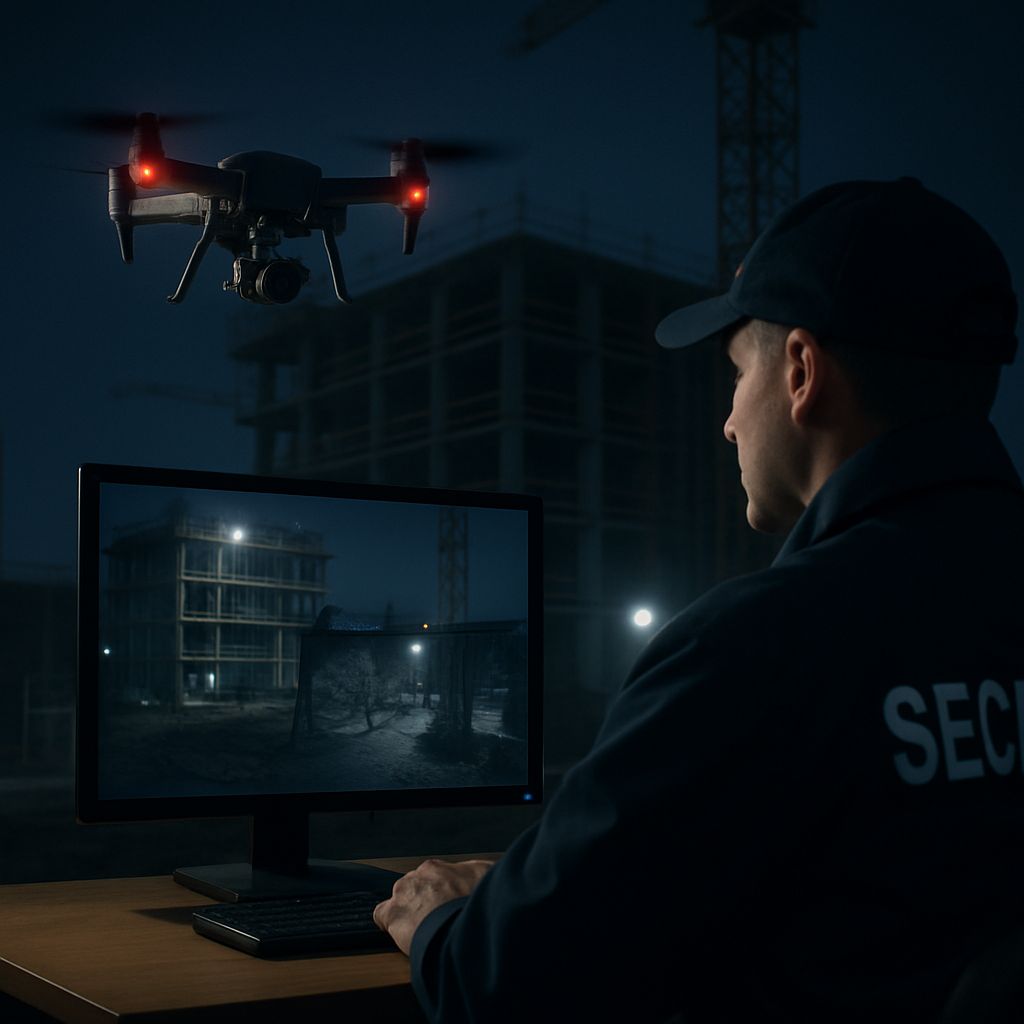
Contemporary security drones come with high-definition cameras, infrared sensors, and thermal imaging that stream live footage directly to a security operations center or a remote monitoring interface. Unlike fixed cameras, a drone can reposition instantly — flying to the exact location of a triggered sensor, following a suspicious vehicle, or conducting a sweep of a flagged area in real time. That dynamic perspective is something no ground-based system can replicate.
Thermal imaging is especially useful after sunset or in conditions with low visibility, such as fog or smoke, where traditional cameras are almost useless. A drone fitted with thermal sensors can detect the heat of the human body through the darkness, making patrols at night truly effective instead of just being a routine.
Self-Guided Patrols and Timed Surveillance
One of the most operationally significant features of modern security drones is the ability to fly pre-programmed patrol routes on a set schedule — with zero human input required once the route is configured. These self-guided patrols can be timed to cover vulnerable windows like shift changes, overnight hours, or periods when foot traffic drops and intruder risk rises. The drone takes off, completes its route, returns to its docking station, recharges, and repeats. It doesn’t get tired, distracted, or call in sick.
Drone-in-a-box systems, which are drones that are kept in a weatherproof automated docking station on-site, make it possible for businesses to have 24/7 coverage without the need for continuous staffing.
Threat Detection and Automated Alerts Powered by AI
Drone security transcends traditional surveillance in this area. Drones equipped with AI do more than just record their surroundings — they interpret them. These systems use computer vision and machine learning models to differentiate between a fox crossing a boundary and a person slicing through a fence. They can identify license plates, flag vehicles that are not authorized, track people across a large property, and send automated alerts as soon as something out of the ordinary is detected. Security teams receive an immediate notification with video context, enabling them to make informed decisions about how to respond within seconds of a threat emerging. For more information on enhancing safety, check out how mobile patrol services enhance safety.
How Drones Improve Business Security
The benefits of drone security aren’t just hypothetical. They offer real, tangible improvements to business security, filling in the gaps that traditional security methods can’t cover.
Greater Area Coverage With Less Resources
One drone can monitor an area that would necessitate several stationary cameras and numerous security staff to patrol on foot. For big facilities — for instance, a 50-acre industrial site or a vast logistics hub — that coverage efficiency equates directly to cost savings. Companies aren’t substituting their entire security infrastructure with drones; they’re employing drones to expand the reach of what they already have, covering more territory without proportionally increasing the number of employees or the cost of hardware installation.
Quicker Incident Response Compared to Ground-Based Teams
When it comes to a security incident, time is of the essence. The longer a threat is left unattended, the more harm — be it physical, financial, or reputational — accumulates. Ground-based response teams are restricted by geography, traffic, and the time it naturally takes a person to travel from one location to another.
Within 30 seconds, a security drone can fly from its docking station and be over its target location. This response time is virtually impossible for any ground-based team to match, especially on large properties where a perimeter breach could be hundreds of meters away from the nearest guard post.
The real game-changer is that the drone comes equipped with eyes — it can stream live video back to a security operations center before the human response team even reaches their vehicle. This allows decision-makers to see in real-time what they’re dealing with, how many individuals are involved, and which direction a threat is moving. This information completely changes the way a response is coordinated.
Automated alert systems take this to the next level. When a drone equipped with AI detects something out of the ordinary, it doesn’t wait for a human to notice it on a screen. It identifies the threat, sends the closest available drone, and at the same time alerts the security team — all within seconds of detection.
Real-World Example: At a large logistics facility using autonomous drone patrols, a perimeter breach triggered an automated drone dispatch at 2:14 AM. The drone was on-site and streaming live footage by 2:14:28 AM — 28 seconds after the alert fired. Ground security personnel arrived at the location with full situational awareness already in hand, having watched the intruder’s movements live on their mobile interface during transit.
Reduced Risk to Human Security Personnel
Sending a security guard to investigate an unknown threat — a dark corner of a warehouse, a suspicious vehicle at a remote gate, an active disturbance on a large property — carries real personal risk. Drones fundamentally change the risk equation by performing the initial threat assessment remotely. The guard only moves in once the drone has confirmed what they’re dealing with, where the threat is located, and what level of response is actually needed. That’s not just smarter security — it’s safer security for the people doing the job. For more on how drones enhance safety, explore how mobile patrol services enhance safety.
Discouraging Criminal Activity
Having a drone in plain sight is a strong deterrent. When a drone is seen hovering over the boundary of a property or actively patrolling it, it sends a clear message to potential intruders that the property is watched, active, and capable of responding quickly — a very different message than what a stationary camera sends. Studies in physical security consistently support the idea that visible, active surveillance significantly reduces opportunistic criminal activity. For businesses grappling with theft, vandalism, or trespassing, the value of this deterrent alone can justify its use. Learn more about perimeter security strategies to enhance your business protection.
The Current State of Drone Security in Business
Drone security isn’t exclusive to one particular industry or type of building. The most surprising aspect of the current situation is the breadth of drone deployment and the variety of uses across different sectors.
Whether it’s an energy plant or a concert, drones are being customised to meet the unique security needs of each setting. The core technology remains the same, but the usage is adapted. Here are some of the places where this is happening today.
Factories and Storage Facilities
Factories and large storage facilities are some of the most attractive targets for thieves and vandals, and also some of the most difficult places to secure. Expansive outdoor areas, numerous entry points, potential security lapses during shift changes, and valuable stock create a complicated security situation that traditional security systems have difficulty handling effectively. For businesses looking to enhance safety, mobile patrol services can offer a robust solution to these challenges.
Typical Security Issues at Industrial Locations:
- Perimeter invasions at unmanned entrances during non-business hours
- Stolen cargo from loading areas and outdoor storage spaces
- Unauthorized vehicles entering restricted areas
- Equipment tampering and copper wire theft
- Internal threats and inventory loss during shift changes
Drones can solve these problems by providing constant aerial coverage over the entire facility — not just where cameras are located. Automated patrols during the night, when human guards are most fatigued and the risk of intruders is highest, have proven to be particularly effective at detecting and preventing perimeter invasions before they become serious.
Drone camera systems with AI-powered license plate recognition enable security teams to instantly detect unauthorized vehicles as soon as they come into the camera’s field of view. This eliminates the need for a person to manually review the footage. This level of automation is what makes drone security a viable option for large-scale industrial operations.
Big Business Properties and Campuses
Business campuses, malls, mixed-use properties, and university campuses all have one security problem in common: they are intended to be open and accessible, which makes them inherently vulnerable. Security management across a property with dozens of access points, large public areas, parking garages, and interior buildings necessitates a multi-tiered approach that static infrastructure alone cannot provide.
Security teams can use drones to monitor commercial properties from above, providing a view of crowd behavior, vehicle movement, and perimeter activity that is impossible to achieve with a ground-level camera system. This elevated perspective is particularly useful during periods of high traffic, when it can be hard to spot unusual behavior from the ground.
Security Challenge Fixed Camera Solution Drone-Enhanced Solution Parking lot monitoring Multiple fixed cameras with blind spots Single drone covers entire lot dynamically Perimeter patrol Static coverage at key points only Continuous aerial patrol of full boundary Incident response Alert triggered, guard dispatched manually Drone on-scene in under 30 seconds After-hours monitoring Recorded footage reviewed after the fact Live AI-monitored autonomous patrol
The combination of live aerial oversight and AI-powered anomaly detection means that security teams on commercial properties can shift from reactive to genuinely proactive — identifying developing situations before they become incidents requiring emergency response.
Securing Remote Assets Like Pipelines, Farms, and Solar Fields
Properties that are far from human infrastructure are often the most difficult to secure. This includes pipelines that stretch across hundreds of kilometers, farms that cover thousands of acres, and solar fields in remote desert locations. The problem with these properties is that there is simply too much ground to cover with traditional security methods. However, drone patrol systems, often using drone-in-a-box setups that operate completely autonomously, can be deployed at these sites. This allows businesses to consistently monitor assets that would otherwise be virtually unmonitorable outside of scheduled human inspections.
Event Security and Crowd Monitoring
Large events such as concerts, sports games, outdoor festivals, and corporate gatherings require intense, temporary security. The density of the crowd, changing perimeter conditions, and short time frames make traditional security methods both costly and logistically complicated. Drones give event security teams real-time crowd mapping, which helps identify dangerous crowd density buildups, track persons of interest across a large venue, and coordinate ground-level security responses with aerial situational awareness that wasn’t available ten years ago.
Aside from crowd control, drones at events can oversee parking lots and the surrounding fences, identify attempts at unauthorized entry, and provide a documented aerial overview of the event that can be used for security and legal purposes in the future.
How Drones Work With Your Current Security System
When considering drone security, a common question is whether it requires a new infrastructure. In almost every case, the answer is no. Drones are designed to work with the security systems that businesses already have in place — CCTV networks, access control platforms, alarm systems, and IoT sensors — making the entire security stack smarter and more responsive without requiring a complete overhaul.
Linking Drones with CCTV and Access Control Systems
Contemporary drone security systems can be incorporated directly into current video management systems (VMS). This means that the footage from the drone is fed into the same monitoring interface that security teams are already using for their fixed camera network. There’s no need to learn a separate system or set up a parallel monitoring system. The drone simply becomes another camera in the network, but with the added benefit of being able to reposition itself anywhere on the property in a matter of seconds.
Integrating access control elevates this process. When an access control event occurs — a badge scan failure, a door left open too long, or unauthorized entry into a restricted area outside of designated hours — it can immediately activate a drone to go to that exact location. The drone arrives, evaluates the situation, and sends footage back to the monitoring team before a human response is even determined. That seamless automation between access control and drone response is where substantial security gaps are eliminated.
What this means in practice is that every event that triggers a security alarm – whether it’s a motion sensor, an anomaly in access control, a perimeter alarm, or an AI detection flag – can immediately command a physical aerial response. This is a fundamentally different capability than what any combination of fixed cameras and guards can offer.
Combining IoT and Smart Sensors
When drone systems are able to communicate with IoT sensors on the ground, they form a security ecosystem where the whole is truly greater than the sum of its parts. For example, if a vibration sensor on a perimeter fence detects unusual activity, it can automatically send a drone to the affected area. If a thermal sensor in a server room detects an abnormal heat signature, it can trigger an overhead inspection. If a smart motion detector in a restricted zone detects unauthorized presence, a drone can be overhead before a human even receives the alert notification. This level of integration transforms a set of individual security tools into a coordinated, intelligent response system. For more insights on enhancing perimeter security, consider these expert tips for perimeter security.
Drone Security Is On the Rise
Drone security is becoming more and more popular. In fact, 70% of top security companies are planning to start using drones. The market for video surveillance and analytics, which includes drone security, is growing faster than any other part of the physical security sector around the world.
The surge in the use of drones for business security isn’t just due to the excitement surrounding new technology. It’s also because of the tangible results. Companies that have implemented drone security systems have seen a decrease in response times and security-related losses. In many instances, they have also seen a decrease in overall security operational costs, even with the initial investment in technology. As drones become more affordable and AI software becomes more advanced, the ROI for business drone security is only getting better.
The Outlook for Drone Security
Today’s drone security systems are certainly impressive, but they’re just the beginning. As this technology evolves, we can expect to see security systems that not only react to threats more quickly than humans can, but also predict them before they occur.
Three intersecting trends are propelling the evolution of business security drones: improvements in autonomous function, increasingly complex AI pattern identification, and more profound integration with smart city and emergency response systems. Each of these changes is a significant advancement in its own right. Collectively, they’re forming a security model that is unlike anything we have seen before.
Rewrite the following human content into human content:
Key Trends in Drone Security Technology that are Shaping the Future:
Trend in Technology Current State Capability in the Near Future Patrol that is Autonomous Routes that are pre-programmed, operation that is scheduled Patrol that is self-directed and dynamic based on data of risk in real time Detection of Threat by AI Flagging of anomaly and alerts that are automated Assessment of threat that is predictive before incidents take place Integration of System Connectivity of CCTV, control of access, sensor of IoT Interoperability of services of emergency and smart city that is full Coordination of Fleet Dispatch of single drone per event Response of multi-drone that is coordinated with roles that are AI-directed Oversight by Human Monitoring that is remote with decision-making by human Oversight that is based on exception with automation that is near-full
What is significant about these developments in a particular manner is the speed with which they are moving from being a prototype to being produced. Technologies that seemed to be years away in 2020 are being deployed in operations of commercial security today. The curve of acceleration in this space is steep, and businesses that understand where the technology is heading are positioned in a better manner to make investments in infrastructure that remain relevant as capabilities evolve.
It’s also important to remember that these advances aren’t happening in a vacuum. The same AI infrastructure that’s improving drone security is also making strides in related fields like autonomous vehicles, smart building management, and industrial automation. This means that the core technologies are being developed on a large scale, which is reducing costs and increasing capability more quickly than any single industry’s R&D budget could manage on its own.
Drone Patrols That Operate With Limited Human Intervention
Autonomous drones in the current generation follow preset routes and react to alerts. However, they still need humans to set those routes, review flagged events, and make response decisions. The next phase will eliminate most of this human intervention. Future autonomous drone systems will change patrol patterns based on real-time risk scoring, past incident data, and environmental conditions. In other words, they will make their own operational decisions about where to focus surveillance resources at any given time. A drone that notices increased vehicle activity near a perimeter at 3 AM will adjust its patrol to prioritize that zone, without waiting for a human to instruct it to do so. For businesses looking to enhance security, understanding how mobile patrol services enhance safety can provide valuable insights.
Anticipatory Security With AI Pattern Recognition
Existing AI drone systems are reactive — they identify anomalies that are already occurring and activate a response. Anticipatory AI goes one step beyond by examining behavioral patterns over time to pinpoint pre-incident indicators. If a particular vehicle has driven around a facility perimeter multiple times across different nights without ever stopping, an anticipatory AI system flags that behavioral pattern as a potential threat indicator and intensifies monitoring — before any actual breach attempt happens. This transforms drone security from a reactive tool into a truly proactive one, where the system is striving to prevent incidents rather than merely document them.
Collaboration with Smart City Infrastructure and Emergency Networks
More and more, individual business drone security systems are being built to interact with larger city infrastructure. In smart city environments, a security event at a commercial facility could automatically share real-time drone footage with city emergency services, allow law enforcement to take direct feed access during an active incident, and coordinate drone coverage with city-operated UAV systems — all through integrated data-sharing protocols that require no manual handoffs between systems.
For businesses in high-risk industries, the integration of emergency networks is especially beneficial. Whether it’s a security breach at a chemical storage facility, a fire at an industrial site, or an active intruder situation at a corporate campus, being able to immediately share aerial situational awareness with first responders who are en route but haven’t yet arrived on scene can be a game-changer.
Companies that are currently investing in drone security infrastructure are often choosing platforms with open API architectures and standards-compliant data protocols. This means that their investment today will not become obsolete as smart city integration capabilities mature. Instead, it will form the basis of a more powerful system. For businesses looking to enhance their security measures, understanding alarm response services is essential to ensure comprehensive protection.
Frequently Asked Questions About Drone Security Services
As more businesses begin using drone security, the same questions frequently arise from those considering the technology. Here are straightforward answers to the most often asked ones.
Is it Legal to Use Security Drones for Business?
Indeed — it is legal to operate commercial drones for security in most areas, but it is subject to regulatory frameworks that differ by country and, in some cases, by region within a country. In the United States, the FAA governs commercial drone operations under Part 107 regulations, which mandate that drone operators acquire a Remote Pilot Certificate, register commercial drones, and comply with airspace restrictions including altitude limits and no-fly zones around airports and sensitive infrastructure. For businesses looking to enhance their security measures, understanding alarm response services is crucial.
Aside from federal aviation regulations, businesses also need to consider privacy laws when using security drones. Recording individuals on private property is usually acceptable for security purposes, but recording footage that goes onto public spaces or neighboring private property can raise additional legal issues depending on local laws and state privacy laws. It is essential to work with a drone security provider that understands all the regulations, not just the aviation rules, before using the drone.
Many of the most popular drone-in-a-box security platforms are designed to be compliant with regulations. This is built into their operating software. Features include geofencing to stop the drones from flying into restricted airspace. They also have logging systems. These document the drones’ flight paths and operational parameters. This is done to verify compliance. For further insights into enhancing safety, consider exploring how mobile patrol services enhance safety.
Business Drone Security Deployment: A Quick Compliance Checklist:
- Make sure any drone operators have FAA Part 107 certification (or use an automated platform that operates within compliant parameters)
- Register all commercial drones with the FAA (required for drones over 0.55 lbs)
- Check local airspace restrictions and set up geofencing accordingly
- Look into state and local privacy laws that govern aerial surveillance of individuals
- Write down drone use policies and disclose surveillance activity as required by the law
- Ensure that your drone platform provider stays compliant with changing FAA Remote ID requirements
The regulatory requirements in this area are changing rapidly, especially when it comes to Remote ID — a system that lets drones broadcast their identity and location while they’re flying, similar to a digital license plate. FAA Remote ID compliance became mandatory for most commercial drones in the United States in 2023, and businesses should make sure any drone hardware or platform they use is fully compliant.
What Is the Cost of Implementing Drone Security for a Business?
The cost of implementing drone security for a business is contingent upon the scale of deployment, the extent of automation required, and whether a business buys the hardware outright or subscribes to a drone-security-as-a-service model. Commercial security drones with basic camera payloads at the entry level can begin at $1,500 to $5,000 per unit. On the other hand, enterprise-grade systems with thermal imaging, AI processing, and automated docking stations can cost between $15,000 to $50,000 or more per installation point. For large facilities that require multiple docking stations and full autonomous coverage, the total deployment costs can be significantly higher. However, they typically compare favorably to the equivalent cost of additional human security personnel when modeled over a 2-3 year period.
The as-a-service model for drone security, where a provider maintains the hardware and charges a monthly fee, has made it easier for businesses to access the technology without needing to make a large upfront investment. This model changes drone security from a capital expenditure to an operational one, which is beneficial for businesses that need to know their security costs ahead of time and don’t want to deal with the complexity of maintaining drone hardware themselves.
Are Drones Able to Completely Take the Place of Human Security Guards?
Not quite — and the most successful security operations aren’t attempting to make that swap. Drones and human guards play fundamentally different roles in a security operation, and the value proposition of drone technology is most powerful when it’s seen as an addition rather than a substitute. For example, comparing unarmed guards with remote surveillance solutions highlights the complementary nature of different security measures.
Drones are exceptional at quickly covering large areas, responding to alerts immediately, operating non-stop without getting tired, and providing an aerial view of a situation that no human can replicate on foot. However, drones cannot physically intervene in an incident, make complex decisions in unclear situations, directly communicate with individuals on-site, or perform the human functions – such as presence, authority, and de-escalation – that a trained security professional brings to an active situation.
The most effective deployment model sees drones as the initial line of detection and assessment, with human security personnel acting as the response and intervention layer. The drone arrives on the scene first, ascertains the situation, and provides the responding security officer with all the necessary information to intervene effectively and safely. This is a more efficient use of human security resources, not a replacement of them.
- Drones excel at: Perimeter monitoring, autonomous patrol, rapid alert response, aerial situational awareness, continuous after-hours coverage, and large-area surveillance
- Humans excel at: Physical intervention, de-escalation, on-site decision-making in complex situations, stakeholder communication, and judgment calls requiring contextual understanding
- The winning combination: Drones handle detection and assessment; humans handle response and intervention — with drones providing real-time aerial intelligence that makes every human response faster, safer, and better-informed
How Long Can a Security Drone Stay Airborne During a Patrol?
Flight endurance is one of the most frequently cited limitations of drone security systems, and it’s a legitimate operational consideration. Most commercial security drones have a flight time of 25 to 45 minutes per battery charge under normal operating conditions. Wind, payload weight (thermal cameras and AI processing hardware add weight), and temperature all affect actual flight time in the field — cold weather in particular can reduce battery performance meaningfully.
Drone-in-a-box systems solve this problem by automating battery changes or recharging cycles. This allows a single drone to return to its docking station, recharge, and redeploy without the need for human intervention. For facilities that require true 24/7 aerial coverage, deploying multiple drones with staggered patrol schedules and automated docking ensures continuous coverage, even when individual drones are recharging. The operational model is less focused on maximizing the endurance of a single flight and more on designing a system architecture that provides continuous coverage through coordinated drone management.
Who Can Access Drone Security Footage and How is it Stored?
Drone security footage is typically stored in one of two ways: on the drone or docking station hardware, or uploaded to a cloud-based video management platform in real time. Most businesses use cloud storage with encrypted transmission, which allows authorized security personnel to access footage remotely through secured interfaces. This also allows for a centralized audit trail of who has accessed what footage and when.
The way drone footage is accessed is the same as any other sensitive security data. Who can view live feeds, review recorded footage, export clips, or modify system settings is determined by role-based access permissions. Security operations managers usually have full access; individual guards may have live-feed access during active incidents but limited access to historical recordings. Any footage shared with law enforcement during an incident investigation should be documented through a formal chain-of-custody process to ensure it remains admissible as evidence.
Depending on the area and industry, the length of time drone footage is stored varies. Certain sectors, such as financial services, healthcare facilities, and critical infrastructure, have specific regulations regarding how long surveillance footage must be kept and how it must be protected. Prior to deployment, businesses should develop comprehensive, written data governance policies for drone footage, including retention periods, access permissions, breach notification procedures, and protocols for responding to legal requests for footage access. Establishing this framework before the system is operational is much simpler than retrofitting it after footage has already been gathered.